Skip to product information
1 of 1

Lead Glass Pro

X-Ray Lead Glass

X-Ray Lead Glass

Regular price $696.00 USD
Regular price Sale price $696.00 USD
Sale Sold out
Shipping calculated at checkout.
Width
Height
Visa
Mastercard
Diners Club
Discover
American Express
PayPal
Shop Pay
Apple Pay
Google Pay
Do you have a size not listed? Click below for a FREE
No Obligation Quote on this product
REQUEST A QUOTE
View full details
FREE Shipping Across the US
Clear and Competitive Pricing
High-quality products with no middlemen involved
Industry Leading Equivalency
Wide range of standard sizes, options of custom
Extended Warranty and Return Policy

X-Ray Lead Glass

We provide lead glass for your project-specific requirements. Select from standard sizes or request a quote for custom sizes or lead thicknesses.

X-Ray Lead Glass purchases include free shipping.

All the x-ray leaded glass listed here meet 2mm lead equivalency based @ 150kvp. We offer higher lead equivalencies if required.

While this is the most common lead equivalency for general x-ray rooms used by doctors, dentists, chiropractors, and medical centers; you will still need to check with your local health official or radiation physicist to determine the required lead shielding for your room.

To request a quote on a custom size or lead equivalency Click Here

Standard X-Ray lead glass does not meet impact resistant requirements to be used in doors or within 24" of doors.

Impact Resistant X-Ray Safety Glass is available upon request and is permanently labeled as safety glass in compliance with ANSI Z97.1 and CPSC 16 CFR Part 1201 CAT II for impact resistance.

Contact us at sales@leadglasspro.com for a formal quote for custom sizes or multiple windows on one order.

Key Features

  • Over 50 standard sizes up to 96" x 48"
  • 2 to 3 day fabrication time, 1 to 4 day transit time. 98.4% of customers receive their order within 1 week
  • Many x-ray protective shielding levels available
  • Safety rated impact resistant or laminated available upon request
  • Available with lead lined telescoping frames for walls or lead lined vision frames doors
  • Our x-ray protective lead glass meets Federal Specification DD-G-451 and ASTM C1036 requirements and all applicable current NCRP and ICRP lead glass criteria and standards in physical quality descriptions.
  • Our Lead Glass also meets or exceeds National Council of Radiation Protection (NCRP) Report No. 49 and No.147, and also ICRP lead glass criteria and standards in physical quality descriptions and required densities.

Impact resistant X-Ray safety glass is available upon request and is permanently labeled as safety glass in compliance with ANSI Z97.1 and CPSC 16 CFR Part 1201 CAT II for impact resistance.

Laminated Lead glass is available upon request and meets ANSI Z97.1, CPSC 16 CFR 1201, and ASTM C1172

X-Ray Glass is:

  • Available in 1.6mm, 2.0mm, 2.4mm, 3.2mm and 3.7mm lead shielding equivalences and higher ratings are available upon request.
  • The highest density x-ray lead glass available for the most efficient medical radiation shielding quality, and yet also allowing approx. 88% spectral light transmission.
  • Uniformly dense and is a composition of high quality materials providing a dependable shielding value.
  • Utilized for medical x-ray, gamma, alpha and beta photon shielding only.
  • Not for thermal neutron or fast neutron shielding. X-Ray lead glass will NOT shield against Magnetic Resonance Imaging (MRI), electro-magnetism or radio-frequency, ultrasound, laser or any non-ionizing types of radiation.

LEAD GLASS FOR X-RAYS

X-Ray Lead Glass is annealed glass that contains lead oxide and other heavy metals. It offers protection against radiation by absorbing the energy of the radiation. Lead glass is used in many medical environments, from dentist offices to hospitals, laboratories where x-rays and other radiation therapy is tested, and even industrial applications like x-ray imaging of welds on airplanes and pipelines.

Lead glass is primarily used to protect x-ray technicians and other bystanders in a medical office building or hospital and researchers in medical environments where x-ray diagnostic imaging is taking place. This glass is used to protect from gamma and x-ray radiation in CT scanners, PET scanners, general x-ray rooms, panoramic x-rays, and many more.

Due to the magnetic component of MRIs, lead glass cannot be used in these environments.

LEAD GLASS PROTECTION AND USES

Leaded glass is a reliable form of protection that can be utilized in many different applications throughout the medical research and treatment field. Lead glass is created to protect against gamma-ray and x-ray radiation. The thickness of the glass correlates with the amount of radiation shielding it provides. For instance, glass with 2.0 mm Pb is 8mm (5/16") thick and provides the equivalent amount of protection received from a 2 mm thick lead lined wall.

The reason Lead glass is so effective is that it is clear, so it provides protection while also providing an effective way to observe the patient or isotope on the other side of the glass. This helps medical professionals do their jobs effectively every day, whether it is observation and research or actively assisting in radiation tests with patients, without risking long-term radiation exposure.

We carry over 80 stock sizes ready to ship in just 3 days after order placement. Our custom size glass also ships in just 5 working days and we have no cutting charge. We fabricate our glass to the specific needs and requirements of the medical office, hospital, or laboratory.

Additionally, there are other uses for lead glass that extend beyond the medical field. These are a few common uses and applications that are not strictly medical:

  • Airport security x-ray stations
  • Industrial x-ray imaging of welds
  • Electron Beam shielding
  • Non-Destructive Testing (NDT)
  • Farnsworth–Hirsch Fusor shielding

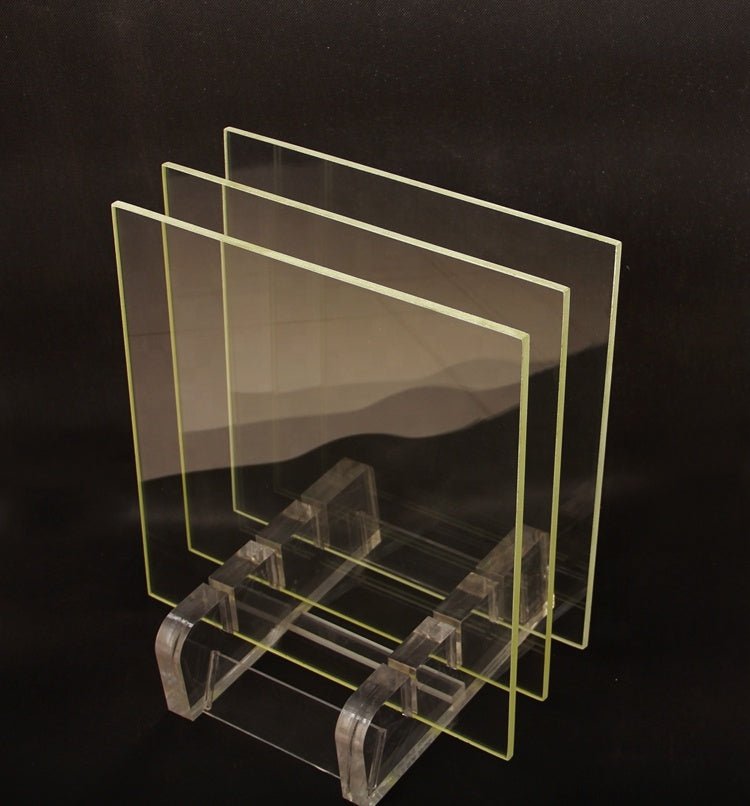
All industries that use Lead glass are drawn to this type of glass because of its safety and its properties. However, lead glass is also preferred because of its versatility, in addition to being able to be customized in size, shape, and thickness; though the main use will continue to be for the medical or diagnostic imaging field. In appearance, lead glass has a light yellow hue. This light yellow still allows for visibility and light transmission but also helps keep light from reflecting directly as translucent glass does.

TYPES OF LEAD GLASS THAT LEAD GLASS PRO OFFERS

All the x-ray leaded glass products available through Lead Glass Pro either meet or exceed the National Council of Radiation Protection (NCRP) Report No. 49 and No.147, as well as ICRP lead glass criteria and standards in physical quality descriptions and required densities. There are many different lead glass options available through Lead Glass Pro.

Here are some of the specific options that are available:

The glass products that are listed here meet a minimum of 2mm lead equivalency based at 150 KVP. However, Lead Glass Pro also offers higher lead equivalencies if required.

While this is the most common lead equivalency for general x-ray rooms used by doctors, dentists, chiropractors, and medical centers, it is still required that you check with your local health official or radiation physicist to determine the required lead shielding for the room(s) in question.

INFORMATION ABOUT LEAD GLASS PRO’S LEAD SHIELDING

  • Lead Glass Pro offers the highest density x-ray lead glass available for the most efficient medical radiation shielding quality, which also allows approximately 85% spectral light transmission.
  • Lead Glass Pro ensures that its materials are uniformly dense and have a high-quality composition, which provides a dependable shielding value.
  • Lead Glass Pro’s X-Ray Lead Glass is approved for the medical x-ray, gamma, alpha, and beta photon shielding only.
  • X-Ray Lead glass is NOT for thermal neutron or fast neutron shielding. X-Ray lead glass will NOT shield against Magnetic Resonance Imaging (MRI), electro-magnetism or radio-frequency, ultrasound, laser or any non-ionizing types of radiation.
  • Lead Glass Pro x-ray protective lead glass meets Federal Specification DD-G-451 and ASTM C1036 requirements and all applicable current NCRP and ICRP lead glass criteria and standards in physical quality descriptions.

Lead Glass Pro offers over 80 standard sizes, up to 96" x 48". Therefore, many customers do not have a problem custom-fitting the glass into one of the standard sizes.

Additionally, are many different glass lead equivalencies available from Lead Glass Pro. Some of the most common thicknesses are:

  • 1.6mm
  • 2.0mm
  • 2.4mm
  • 3.2mm
  • 3.7mm

If your application requires a higher lead shielding equivalence, please submit a quote request to sales@leadglasspro.com

LEAD GLASS FABRICATION TIME

Lead Glass Pro does everything in its power to have an easy and quick transaction. Therefore, we have achieved a typical fabrication time of only 3 days. The transit time is only typically 1 to 4 days. That means that most Lead Glass Pro customers have their products, from start to finish, at their doorstep in a week.

Many Lead Glass Pro customers are thrilled at the speed with which our company delivers their custom x-ray lead glass. With other companies, it could be 5 or more weeks before an order is filled and delivered. However, Lead Glass Pro knows that when you need Lead Glass, especially for the medical field, you need a quick turnaround time. That is why the Lead Glass Pro team works so diligently to get orders out in such a timely fashion, while also maintaining the high level of satisfaction we are known for. Additionally we ship anywhere in the US and American territories as well as Mexico and Canada.

X-RAY LEAD GLASS ADD-ONS AND OPTIONS

In addition to having many x-ray protective shielding levels, thicknesses and sizes available, Lead Glass Pro also offers a host of options to make your Lead Glass fit your needs precisely. Here are the add-on options that are available upon request:

NOTE:

  • Customer must verify lead equivalency meets the shielding requirements of the room
  • Payment will be required to begin fabrication.
  • Once fabrication begins, no cancellations or changes may take place
  • By placing this order and paying you accept and have verified sizes, quantities, lead equivalency, and accept the terms for shipping / receiving and returns / replacement
  • All products must be inspected upon delivery in the presence of the delivery driver. Once the product is received and the delivery receipt is signed, no claims for damage will be entertained. If there is damage, note it on the delivery receipt and contact us immediately.
  • All radiation shielding calculations must be determined by a radiation physicist.
  • A forklift is required for offloading sizes larger than 24" x 24"
  • Our products can only ship to a commercial address. We cannot ship to residential addresses.

Frequently Asked Questions

X-Ray Lead Glass Specifications

Standard Lead Equivalency: All x-ray leaded glass listed here meets 2mm lead equivalency at 150 KVP, with options for higher lead equivalencies if needed.

Higher Shielding Options: Available upon request. Available lead equivalencies include 1.6mm, 2.0mm, 2.4mm, 3.2mm, 3.7mm and higher.

Standards Compliance: Manufactured in accordance with Federal Specification DD-G-451, ASTM C1036, NCRP Report No. 49 and No.147, and other applicable safety standards.

Customization Options

Safety Features: Impact-resistant or laminated leaded glass available on request. Complies with ANSI Z97.1 and CPSC 16 CFR Part 1201 CAT II for impact resistance.

Frames and Add-Ons: Lead-lined telescoping frames for walls, lead-lined vision frame doors, fire-rated units, and mini-blind insulated units available.

Fire Safety: Fire-rated x-ray lead glass insulated glass units are available.

Shipping & Delivery

Free Shipping: We offer free shipping to the lower 48 United States for all x-ray lead glass orders. No hidden fees or additional charges.

Fast Fabrication: Most orders are fabricated within 2 to 3 days and shipped out shortly after. Custom orders are typically shipped within 4 days, providing one of the quickest turnaround times in the industry.

Shipping Methods: Depending on the size and weight of your order, we use various shipping carriers to ensure safe and timely delivery. For larger or heavier items, a forklift may be required for offloading.

Shipping Addresses: We ship to commercial addresses only. Unfortunately, we cannot ship to residential addresses due to safety and handling considerations.

Transit Time: Delivery generally takes between 1 to 4 days depending on your location. We'll provide you with tracking information to monitor your shipment's progress.

Inspection Upon Delivery: To ensure your satisfaction, we ask that you inspect your shipment upon delivery. It's important to check for any visible damage and note it on the delivery receipt. If there is damage, please contact us immediately to resolve the issue.

Returns & Cancellations: Due to the custom nature of our products, once fabrication begins, cancellations or changes are not possible. If you need to change an order, please contact us as soon as possible.

Considerations

Verification Requirements: Customers must verify that lead equivalency meets their radiation shielding requirements. All calculations should be determined by a radiation physicist.

Fabrication and Shipping Policies: Fabrication begins upon payment and cannot be changed or canceled afterward. A forklift is required for offloading sizes larger than 24" x 24".

Inspection Upon Delivery: Products must be inspected upon delivery in the presence of the delivery driver. Any damage must be noted on the delivery receipt and reported immediately.

X-ray glass delivers clear visibility into controlled imaging spaces while providing verified radiation attenuation. Engineered to meet shielding calculations, integrate into rated assemblies, and support inspection-ready construction, it removes complexity from your build without cutting corners on compliance.

The Composition Behind X Ray Glass

For a full breakdown on understanding what X-ray lead glass is, the composition is the right place to start. X-ray glass is a specially manufactured glazing material infused with lead oxide. This composition allows the glass to attenuate ionizing radiation while maintaining optical clarity across the viewing area.

Unlike standard architectural glazing, this material is engineered specifically as X ray shielding glass. Radiation exposure is blocked in accordance with specified lead equivalency levels, determined by equipment output and shielding calculations. That specificity matters because no two imaging rooms carry the same attenuation requirements.

Each lead glass sheet is manufactured to precise tolerances so crews can install it within compatible frames and wall assemblies without field modification. That consistency speeds up installs and keeps inspections on track.

How Radiation Attenuation Works

X-ray glass functions as radiation shielding glass by absorbing and reducing the intensity of X-ray beams. The embedded lead content slows photon transmission, lowering radiation exposure to safe levels outside the imaging room. In practical terms, that means occupants in adjacent spaces stay protected without additional shielding layers.

Shielding performance is measured in millimeters of lead equivalency. This value confirms how much protection the glass delivers relative to solid lead. Matching this specification to project drawings is a baseline requirement for compliance and passing inspection.

Built For Inspection And Integration

We fabricate X-ray glass that meets medical and construction requirements. Our glazing integrates into lead-lined walls, doors, and control room openings with minimal coordination overhead. Fabrication begins within 3 days of approved specifications, and most orders ship in 2 to 4 days. At Lead Glass Pro, our role is to simplify radiation shielding so contractors can move forward with confidence, accurate documentation, and predictable timelines.

X-ray glass is installed in imaging environments where visibility, shielding, and code compliance must align. Proper coordination between wall assemblies, frames, and door systems keeps installation predictable and inspection approval within reach.

Common Installation Locations In Medical Builds

We regularly supply X ray room glass for CT suites, dental operatories, fluoroscopy rooms, and hospital imaging departments. These spaces require clear observation from control rooms while maintaining shielding integrity throughout the full assembly.

A properly specified lead glass viewing window allows technicians to monitor patients safely without compromising attenuation performance. These windows are typically installed in framed wall openings between procedure and control areas, creating a direct line of sight that keeps staff informed and patients protected.

In many builds, contractors install a leaded glass window within a lead-lined wall system. Alignment between glazing thickness, wall shielding, and framing depth is essential to maintain compliance and avoid field modifications that can push back your schedule. Additional applications include:

  • Corridor-facing observation windows in rated walls. These installations require careful overlap between glazing edges and wall shielding to prevent radiation gaps that inspectors will flag during review.
  • Emergency department imaging rooms, where fast patient throughput makes clear sightlines from the control area both a practical necessity and a compliance requirement.
  • Outpatient diagnostic centers, which often handle a high volume of imaging procedures daily and require glazing that holds up to extended operational demands without compromising shielding performance.
  • Veterinary and specialty imaging facilities, where unique room configurations and equipment types may call for custom panel dimensions or non-standard lead equivalency values.

What Inspectors Check And How To Stay Ahead Of It

Successful X ray glass installation begins with verifying lead equivalency, rough opening dimensions, and compatible framing systems. We provide clear specifications so your crew can prepare openings accurately before delivery. Before installation, teams should confirm:

  • Shielding between the wall and the glazing: Any visible gap or misalignment at the perimeter is grounds for a failed inspection, so sealing and overlap details should be confirmed before the inspector arrives.
  • Proper frame installation: Frames that are out of plumb or missing required anchoring can compromise the integrity of the full assembly, even when the glass itself meets spec.
  • Correct lead equivalency documentation: Having verified shielding data on-site speeds up the review process and reduces back-and-forth that eats into your timeline.
  • Assembly alignment with approved drawings: Deviations from the submitted plans, even minor ones, can trigger additional review and delay your certificate of occupancy.

The glazing must be supported evenly, with correct anchoring and glazing stops to prevent stress points. Proper handling during installation also protects clarity and shielding integrity. For door assemblies, many projects integrate coordinated solutions such as door kits with X-ray safety glass

These systems simplify job-site coordination by aligning door cores, frames, and glazing into a single, compliant configuration that ships together and installs without requiring separate subcontractor scheduling.

Inspection And Compliance Considerations

Inspectors review more than just the glass. They also verify:

  • Continuous shielding between the wall and the glazing: Any visible gap or misalignment at the perimeter is grounds for a failed inspection, so sealing and overlap details should be confirmed before the inspector arrives.
  • Proper frame installation: Frames that are out of plumb or missing required anchoring can compromise the integrity of the full assembly, even when the glass itself meets spec.
  • Correct lead equivalency documentation: Having verified shielding data on-site speeds up the review process and reduces back-and-forth that eats into your timeline.
  • Assembly alignment with approved drawings: Deviations from the submitted plans, even minor ones, can trigger additional review and delay your certificate of occupancy.

Designed For Predictable Integration

We design our X Ray Glass systems to integrate with standard framing practices and conventional wall assemblies used in medical construction. Our goal is to remove uncertainty from the process so your crew can prepare openings accurately and install them without unnecessary field adjustments. Fabrication begins within 3 days of approved specifications, and most orders ship in 2 to 4 days to support tight project timelines.

At Lead Glass Pro, our focus is clear execution from submittal to installation. We provide complete documentation, verified lead equivalency details, and straightforward installation guidance. With accurate specifications and dependable production timelines, your team can install confidently, reduce inspection risk, and keep your imaging project moving forward without disruption.

X Ray Glass reduces radiation exposure by combining lead content with optical clarity in a tested glazing system. When properly specified and installed, it supports shielding calculations, protects adjacent spaces, and maintains visibility for medical staff.

Lead Content And Attenuation Performance

Our leaded X-ray glass for radiation shielding is manufactured with lead oxide integrated directly into the glass composition. This allows the material to attenuate ionizing radiation while remaining transparent.

Radiation attenuation works by slowing and absorbing X-ray photons as they pass through the glazing. The level of protection is expressed in millimeters of lead equivalency. This measurement confirms how the glass performs compared to solid sheet lead. Selecting the correct equivalency ensures the shielding aligns with the equipment output and physicist calculations for the room. 

Shielding Within A Complete Assembly

While the glass itself performs the attenuation, shielding compliance depends on the full wall or door assembly. Each lead glass panel must integrate with lead-lined walls, compatible frames, and proper sealing to prevent radiation gaps. Gaps at framing edges or improper overlap with adjacent shielding materials can compromise performance. That is why coordination between glazing size, wall shielding, and framing depth is critical before fabrication begins.

Engineered For Compliance And Clarity

We fabricate X-ray glass to meet specified lead equivalency while maintaining high visual clarity for observation areas. Every panel is cut to order and supported by clear documentation outlining shielding values.

Our focus is practical execution. We provide accurate specifications, predictable fabrication timelines, and guidance that allows contractors to install with confidence and pass inspection without unnecessary rework.

X-ray glass must align precisely with your wall assemblies, shielding calculations, and framing systems. We fabricate to specification so your glazing fits correctly, supports compliance, and installs without field modification or schedule disruption.

Standard Sizes And Cut-to-Order Fabrication

We supply X-ray glass in standard dimensions as well as custom-cut panels based on approved drawings. Each order is fabricated to match the required opening size, shielding value, and mounting method.

The specified X-ray glass thickness depends on the lead equivalency required for the room. Higher shielding levels increase overall thickness and weight, which must be coordinated with framing and structural support. By confirming thickness and dimensions before fabrication begins, we help your team prepare rough openings accurately and avoid resizing on-site.

Custom Panels For Observation And Control Rooms

Many projects require tailored glazing dimensions for control room windows or corridor-facing installations. Whether the application calls for a compact viewing insert or a larger observation window, we manufacture each lead glass panel to align with the project’s shielding and structural requirements.

Our fabrication process supports predictable lead times. Production begins within 3 days of approved specifications, and most orders ship within 2 to 4 days.

Frame Compatibility And System Coordination

Proper framing is essential for compliance and structural integrity. We coordinate closely with compatible systems, including leaded X-ray glass window frames, to ensure that glazing depth and support requirements align with the selected assembly.

Matching frame depth to glass thickness prevents stress points and ensures the glazing performs as tested. When sizes, thickness, and framing are confirmed upfront, installation becomes straightforward, and inspection risk is reduced.

X-ray glass pricing depends on shielding requirements, panel dimensions, and system coordination. Clear specifications upfront allow us to quote accurately, fabricate quickly, and keep your project aligned with budget and schedule expectations.

Key Factors That Influence X Ray Glass Price

The most significant factor affecting X-ray glass price is lead equivalency. Higher shielding requirements increase material thickness and weight, which impacts manufacturing cost and shipping logistics.

Panel size also plays a role. Larger viewing windows require more material and may require reinforced framing support. Custom dimensions, edge finishing, and specialty configurations can further influence pricing. Likewise, thickness and performance requirements should always be verified against shielding calculations before finalizing a quote. Correctly matching specifications prevents costly adjustments later in the build.

Assembly And System Coordination

Pricing may also vary depending on whether the glazing is supplied as a standalone panel or as part of a coordinated system. When projects include integrated frames, door vision panels, or compatible wall shielding components, the overall scope of materials affects total cost.

We provide detailed quotes that clearly outline glass thickness, dimensions, and lead equivalency. This transparency allows contractors and design teams to review specifications with confidence before approving fabrication.

Budget Clarity And Predictable Timelines

We fabricate within 3 days of approved specifications and ship in 2 to 4 days. That speed reduces downtime and helps prevent costly schedule extensions. Our focus is straightforward pricing aligned with inspection-ready specifications. When requirements are clear, cost estimation becomes predictable, and projects move forward without financial uncertainty or last-minute changes.

Selecting the right X-ray glass requires alignment between shielding calculations, wall assemblies, and installation logistics. Clear specifications at the planning stage reduce risk, prevent rework, and support smooth inspection approval.

Confirm Shielding Requirements First

Start by verifying the required lead equivalency in the approved shielding report. Equipment output, room layout, and occupancy of adjacent spaces determine the necessary attenuation level.

Choosing the correct leaded X-ray glass for radiation shielding ensures the glazing performs as calculated. Matching the specified lead value to the architectural drawings prevents substitution errors that can delay inspection.

If shielding requirements change mid-project, fabrication details must be adjusted before production begins. Locking in accurate values before approval protects your schedule.

Coordinate Thickness And Framing

Once shielding levels are confirmed, review the required X-ray glass thickness and verify that the wall assembly and frame depth can support it. Heavier panels require proper anchoring and structural consideration. Frame compatibility matters, and glazing should align with rated wall systems and approved framing configurations. Confirm the following:

  • Frame depth matches glass thickness
  • Wall shielding overlaps properly at openings
  • Structural framing supports panel weight
  • Mounting method aligns with tested configurations

Early coordination between architects, contractors, and our support team keeps installation straightforward.

Consider Room Type And Application

Different imaging environments have different operational needs. A control room window may prioritize wider visibility, while a compact operatory may require a smaller viewing insert. Make sure to check for the following:

  • Size of observation area needed
  • Proximity to high-output equipment
  • Wall rating requirements
  • Door integration requirements

When glazing is part of a lead glass viewing window or incorporated into door systems, the full assembly must be evaluated together rather than as separate components.

Evaluate Installation And Crew Capabilities

Installation planning should reflect real job-site conditions. Confirm that your crew can safely handle the panel weight and that rough openings are prepared before delivery. At Lead Glass Pro, we design our systems for installation by experienced construction teams without requiring specialized shielding subcontractors. Clear installation guidance reduces uncertainty during placement.

Review Documentation And Timeline

Inspection readiness depends on paperwork as much as product performance. Before placing an order, confirm that specification sheets, lead equivalency documentation, and assembly details are included in your submittal package. We begin fabrication within 3 days of approved specifications and ship in 2 to 4 days. Our role is to provide clarity at every stage so your project remains compliant, efficient, and on schedule.